All you need to know about DALI dimmable LED lighting system
By Amy Topsun lighting
DALI, a protocol designed specifically for lighting control, is widely used for scene control and lighting source status feedback. It breathes new life into lighting fixtures, giving each one a unique address. Importantly, the DALI system isn't limited to specific light sources or fixtures; instead, it requires that key components like ballasts and drivers conform to its standards. Together, these components form the luminaire's address system.
What is DALI dimming?
DALI, short for “Digital Addressable Lighting Interface,” is an open alliance of global innovative lighting manufacturers. It originated in Europe in the 1990s. DALI was created to address the lighting industry’s need for a standardised protocol. The first standard, IEC 60929 Ed. 1.0 was released in 2000, supporting individual addressing and bidirectional communication, and was widely acclaimed then. In 2014, DALI released the DALI-2 standard, expanding the directive. In 2017, DALI-2 certification was introduced, verifying and certifying that products meet the DALI-2 standard, significantly enhancing interoperability. As the lighting industry evolves, DALI’s requirements have increased. Following DALI-2, D4i, zhaga-D4i, and DALI+ certifications have been added. These certifications provide detailed classifications based on product functions and interfaces to meet increasingly complex market demands.From the inventor’s perspective, Tridonic introduced the world’s first digital dimming technology, the DSI (Digital Serial Interface) interface, in 1991. DALI, developed on this basis, is the latest digital dimmable technology. In 2000, Tridonic and other manufacturers developed the DALI industry standard, which was incorporated into IEC60929 to ensure compatibility between DALI devices produced by different manufacturers. The World DALI Association was established in 2001. Through the introduction and application of DALI technology, DALI has become the mainstream standard for digital dimming in Europe.
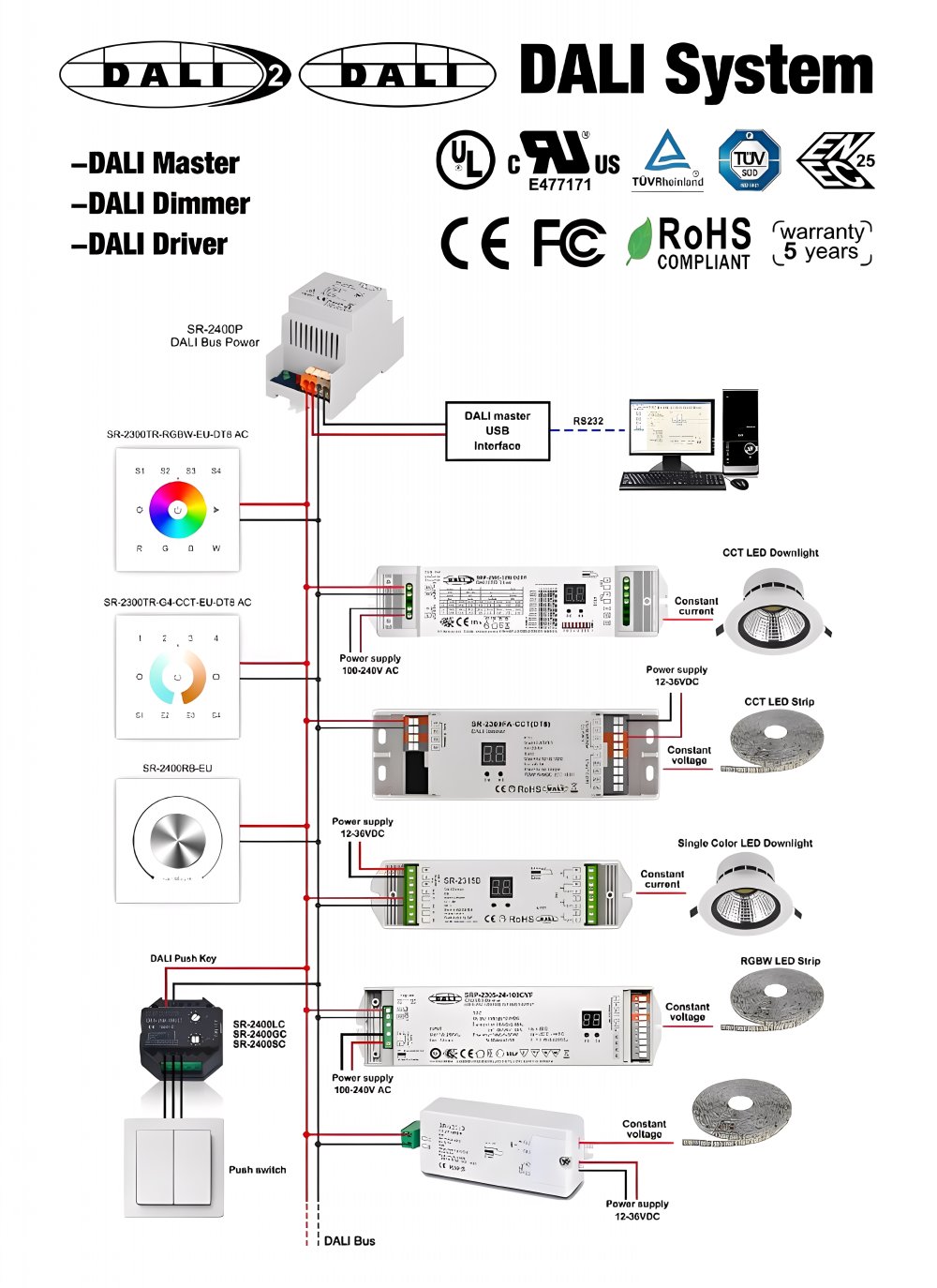 The DALI dimming system provides tremendous flexibility for lighting control. The most significant feature of DALI technology is that each luminaire has an independent address, allowing precise dimming control of individual luminaires or groups of luminaires through the DALI system. The DALI system software allows for independently addressing individual or multiple luminaires on the same or different power circuits, enabling individual control and arbitrary grouping.
DALI Standard Components
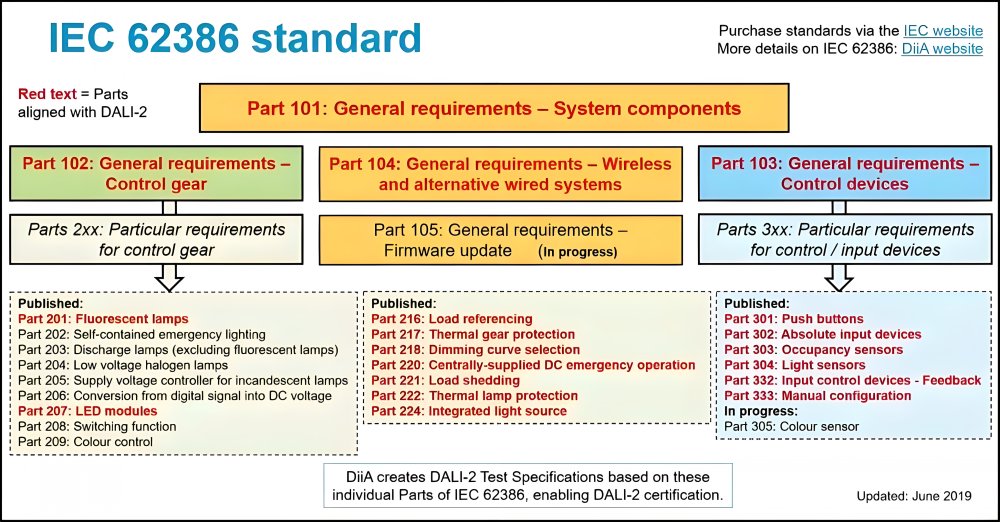
As shown in the figure below, IEC 62386 constitutes the DALI standard system:
1. The Differences between DALI-1 and DALI-2
DALI-2 is an upgraded version of DALI. It adds standardised requirements for DALI control devices based on the original DALI protocol. Mandatory certification enhances compatibility and interoperability between DALI products from different manufacturers.
|
DALI-2 certification |
DALl version-1 registration |
| Includes control gear (e.g., LED drivers)? |
Yes |
Yes |
| Includes control devices (input devices, application controllers) and other devices? |
Yes |
No |
| Latest test sequences, designed to ensure product interoperability, supplied by DALI Alliance to members? |
Yes |
No |
| Test results verified by DALI Alliance? |
Yes |
No |
| All products displayed on DAL! Alliance website? |
Yes |
Yes |
| Status |
Open to Regular and Associate members |
Closed. No further DALI version-1 control gear can be registered and listed on the website |
2. DALI System Components
With the arrival of DALI certification on D4i, many different types of devices can now be connected to a DALI system. Here, we will only introduce the DALI devices commonly required in common application scenarios.
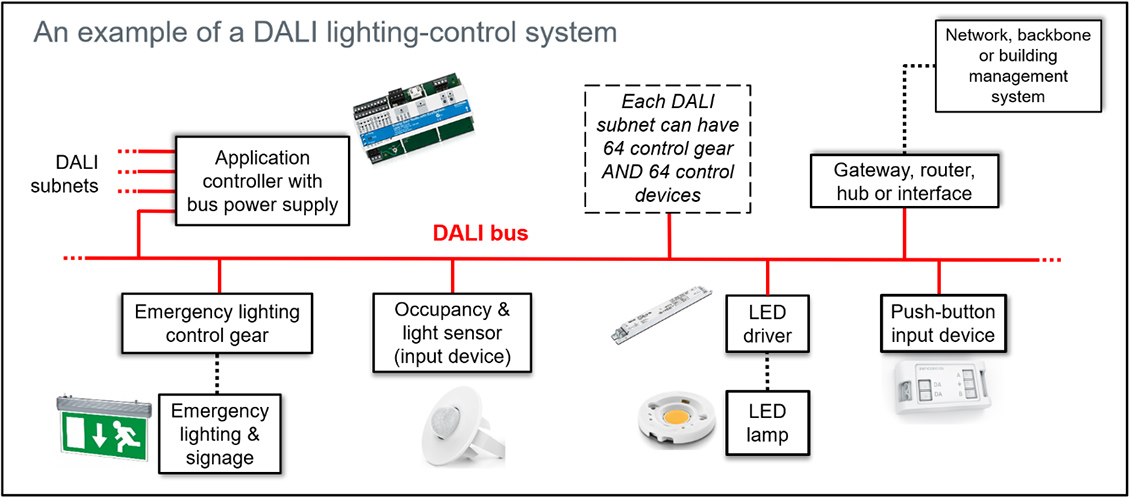 As shown in the figure above,A complete DALI system consists of at least a DALI application controller, a DALI driver, and a DALI power supply. Optional configurations include DALI sensors and a DALI gateway.DALI application controllers (control devices): These are devices that emit DALI control signals and can be lighting controllers, remote controls, switch panels, etc. They may also have external interfaces to facilitate user configuration and management of the entire DALI bus if fully functional.DALI driver (control gear): This device controls the luminaire’s output. It receives dimming commands from the DALI controller and controls the luminaire to the corresponding brightness or colour temperature. It also provides feedback to the controller regarding the luminaire’s operating status, energy efficiency data, and asset data.DALI bus power supply: This device provides the DALI bus voltage, ensuring the proper transmission of control signals and providing the necessary power to devices on the bus. D4i certification requires that DALI drivers have bus power output capability (i.e., Part 250). In this case, a separate DALI power supply device is unnecessary if the driver’s ability is sufficient.DALI sensor (input device): This device is part of the DALI interface and an optional input device. It can be an illuminance sensor (Part 304) or a motion sensor (Part 303). Based on these sensors’ data, the DALI controller adjusts the luminaire’s output.
Advantages of DALI
1. Easy Wiring
- DALI accepts any topology except a ring, and power and control signals are carried on the same cable.Signal lines are polarity-insensitive, making wiring convenient and straightforward. - Wires are made of 2-core 1.0mm² to 1.5mm² standard cable with isolated connectors, regardless of positive or negative voltage. - It can be wired with 220V, minimising wiring requirements.
2. Flexible Control
- The DALI system uses control commands to control individual lights, groups, and announcements. One loop can be up to 300 meters long, with up to 64 control devices (sensors, switches, etc.).- Control units and 64 control devices (sensors, switches, etc.) support scene control, colour control, dimming control, and gradient transitions.- Control devices can draw power from the DALI bus and read device status and information.
3. Strong Compatibility
Officially certified devices from different manufacturers ensure good compatibility and interoperability.
4. Easy Upgrade
No rewiring is required; the lighting system can be reconfigured through software to add devices, modify commands, and improve functionality.
5. Integration with BMS Systems
DALI systems can operate as a standalone system or be integrated into a building management system (BMS) or smart home system as a lighting subsystem.
Disadvantages of DALI
1. Long R&D Cycle
Learning and understanding the DALI standard is required to complete the hardware and software design and pass DALI certification testing.
2. High Cost
Development and certification require significant investment and are expensive.
3. Complex Debugging
Requires specialised knowledge and experience, especially in scenarios with many bus devices. Automatic address assignment can easily cause problems, increasing debugging difficulties.
DALI Features in Lighting Systems
1. Simple wiring (no polarity requirements, no group requirements)2. control of individual devices and groups of devices3. Using broadcasting for overall control4. A simple message structure avoids conflicts between various signals5. Status information feedback (lighting failures can be addressed in a general manner) (Reporting in multiple modes, groups, or individual modes)6. Automatically discovers various dimming devices and DALI rectifiers or transformers7. Group control using intuitive methods (flash or 100% brightness)8. When using the scene function, all lights dim synchronously9. Logarithmic dimming curve, more compliant with human visual requirements10. Each DALI light dimmer light control device is intelligent (it can store individual addresses, group information, light scene settings, light fade time, etc.)11. Light operability parameters can be set (such as the maximum dimming value, which is used for energy saving)12. Configurable dimming steps (effectively 225 dimming steps)13. Detects the type of DALI light control device14. Enables emergency lighting functionality15. Compatible with building management systems (BMS) via a gateway16. No external relays are required to turn the light power on and off; the ballast’s internal relays control the light on and off.
5 Considerations about DALI dimming
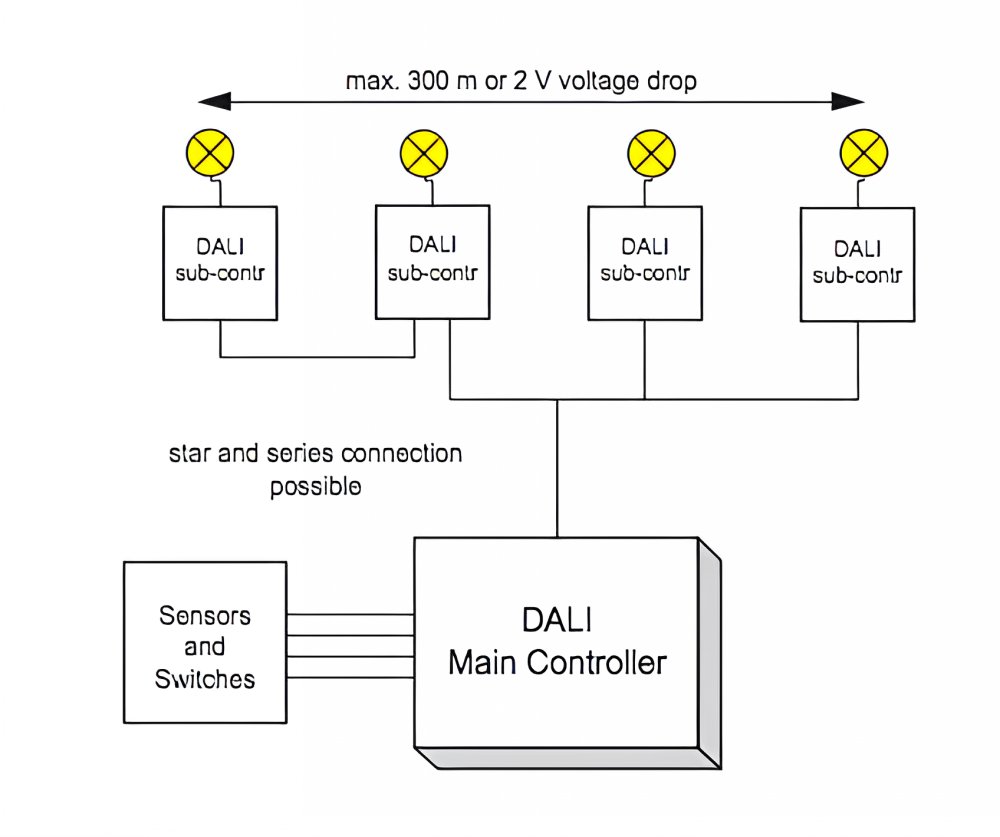 1. Wiring Requirements: A DALI bus must be laid, with a maximum transmission distance of 300 meters.
2. Number of Addresses: A maximum of 64 devices can be connected to a single DALI bus.
3. Protection Measures: Each DALI module requires circuit breaker protection and is connected only to the 220V live and neutral wires.
4. Control Cable Requirements: 1.5mm² copper signal wire can be used for control cables; no special requirements apply.
5. Dimming Curve: DALI dimming offers linear and logarithmic curves, with linear dimming generally used.
FQA:
Q1: What kind of DALI driver should I use with my lighting controller?A1: Select a D4i-certified driver. As most controllers do not ensure it has bus driver capabilities (PART 250). In this case, there’s no need to add a separate bus power supply to the bus.
Q2: How can I confirm which DALI Parts standards a product is certified for?A2: The DALI official website product database link allows you to search for product certifications based on serial number, model number, and other information.
Q3: Why does DALI specify polarity as insensitive, but the ZHAGA standard defines PIN 2 as GND/DA- and PIN 3 as DA+, effectively making them polarity sensitive? Isn’t this a contradiction?A3: DALI official allows polarity-insensitive wiring for specific interfaces, such as ZHAGA and NEMA. In this case, careful wiring is crucial.
Q4: Using the single DA symbol, some drivers’ DALI interface cables don’t distinguish between DA+ and DA-. How should I connect them to the Z-D4i controller?A4:
- Follow the polarity design
Identification of the wire colours clearly indicates positive and negative polarity. For example, if the driver’s DALI interface cable is purple and grey, the purple cable should connect to the controller’s DA+ and the grey cable to the controller’s DA-.- There is no line color distinction, so the driver DALI interface is preferred, with the silk screen facing you. The cable on the top is connected to the controller DA+, and the cable on the bottom is connected to the controller DA-.
Conclusion
With independent addressing and precise dimming control, DALI dimming technology provides an efficient and flexible solution for intelligent lighting systems. Whether for home or commercial use, DALI dimming is a worthy option.
TopSun Lighting has many different kinds of DALI LED lights, like DALI LED linear light, DALI dimmable LED downlight, DALI dimming LED linear track light, etc. Any requirements about DALI dimmable LED lamps, please don’t hesitate to contact us.
Maybe you would like to read 6 types of dimming control methods for LED lighting
Previous
All you need to know about Waterproof IP65 Downlight
Read More
Next
Customized Hotel room numbers signage LED wall lights
Read More